Tonight, there was a gathering of a few students (some former, including myself) who decided to get together to discuss Catholic Social Teaching. Kevin Burke, the head of the Peace and Justice committee for the GMU Catholic Campus Ministry, had put together the group and assigned the discussion to be on Rerum Novarum.
All that attended had something to say on the social teaching's of Pope Leo XIII. The discussion went from the good points to the bad points of the Papal Encyclical and even to one another sharing why some points we thought were bad are really good. It was a fun time shared by all. Most gatherings last an hour to allow students to get to other class projects such as homeworks, but it appeared no one wanted to leave.
With a group full of students such as these, who would want to leave?
If you get a chance, head up to Brion's Grill on Tuesdays at 7:30 p.m. Don't have to be Catholic to discuss, and Tuesdays at Brion's is half price burger day in case you needed another incentive to come.
Tuesday, September 30, 2008


Saturday, September 27, 2008
The BuyOut Bet: Caplan is at it again.
I have to say that I get excited when Caplan wants to make a bet. Anytime someone who knows little about economics but can not help themselves from making outlandish claims; Caplan calls them out. With a gesture of a bet, he tells them that "Talk is Cheap", and that they need to "Put their money where their mouth is." For anyone can say anything, but if you ask them to put money behind their claims, it will prove how much they truly believe in what they say.
Is it time do more Crunches? FT on the Credit Crunch
Samuel Britton of the Financial Times had stated in May this year:
One striking feature of recent events is how slow they have been to hit the real economy. Although the credit crunch was first discerned last August no major area has yet recorded a downturn in activity, as distinct from a growth slowdown. This suggests not that the crisis is coming to an end but that it is slow-burning. The ominous feature is the one I have already hinted at in my reference to the continued trend rise in commodity prices, which could well be part of a long-term shift in the terms of trade against the industrial west, as well perhaps as part of a shift in political and economic power. Here is an area where it will be necessary to adapt to market movements rather than to attempt to reverse them by ill-considered intervention.and recently on discussing Chris Coyne's book After War:
he(being Coyne) accepts the case for occasional intervention for humanitarian reasons or to protect US citizens. His main suggestions are to avoid nation-building types of intervention and adopt free trade, if necessary unilaterally by the US. It is perhaps déformation professionelle for economists to overrate the spillover benefits of the latter. But peace and welfare may depend on how far the next US president accepts the main lines of his analysis – a subject even more important than the current credit crunch.HT to Chris Coyne.
Wednesday, September 10, 2008
Wednesday, August 20, 2008
Immigration Policies are Lame
Thought experiment on labor...
We know that people immigrate for a better life. In the less developed nations, it is usually the lower class that travel to the U.S., and we know that by them coming to the U.S. alone raises the amount they produce. From this estimation alone we know that the immigrant came to the States with only his own human capital, and the increase in production must then be due to other elements found in the U.S.
Comparing the immigrants from less developed nations to those from more developed nations (see Olson's Big Bills Left on Sidewalks) we find that immigrants from more developed nations are more productive and therefore receive a higher wage than immigrants from less developed nations. The human capital from developed nations is substantially higher than that of the less developed nations. With this fact, isn't it strange that the government wants to uphold immigration with a quota? Yet clearly there is a difference between the immigrants from developed nations and less developed nations. Is the government so full of itself it believes it can set the quota to fit all different types of labor?
The more developed nation's immigrants would take the middle class jobs while the less developed nations would work in the lower class jobs within the American economy, so why is it many Americans believe Hispanic immigrants are taking most of American jobs again? Especially since they are in the lower level positions...
Government policy needs to get over itself; the market sets the equilibrium and the U.S. labor economy obviously is no where near the equilibrium for high human capital and low human capital labor.
We know that people immigrate for a better life. In the less developed nations, it is usually the lower class that travel to the U.S., and we know that by them coming to the U.S. alone raises the amount they produce. From this estimation alone we know that the immigrant came to the States with only his own human capital, and the increase in production must then be due to other elements found in the U.S.
Comparing the immigrants from less developed nations to those from more developed nations (see Olson's Big Bills Left on Sidewalks) we find that immigrants from more developed nations are more productive and therefore receive a higher wage than immigrants from less developed nations. The human capital from developed nations is substantially higher than that of the less developed nations. With this fact, isn't it strange that the government wants to uphold immigration with a quota? Yet clearly there is a difference between the immigrants from developed nations and less developed nations. Is the government so full of itself it believes it can set the quota to fit all different types of labor?
The more developed nation's immigrants would take the middle class jobs while the less developed nations would work in the lower class jobs within the American economy, so why is it many Americans believe Hispanic immigrants are taking most of American jobs again? Especially since they are in the lower level positions...
Government policy needs to get over itself; the market sets the equilibrium and the U.S. labor economy obviously is no where near the equilibrium for high human capital and low human capital labor.
Thursday, August 14, 2008
Subway Systems Hacked!
Students from MIT hacked into the Boston Subway system which has similar systems to many of the biggest subways within the world including the DC Metro area. Check out this link to the article and the students pdf presentation upon how easy it is to hack into the system.
Sunday, June 01, 2008
Fulton Sheen quote from Life is Worth Living on Communism and Russia
I have spent a long night in the hospital. Not that there is anything wrong with me, I was spending it with someone dear to me. I had a few books with me. Mises' Theory and History, Hazlitt's Foundations of Morality, and Fulton Sheen's Life is Worth Living. There are great quotes from each book, but I found Sheen's words interesting upon Russia. He is speaking as what a Russian would say to someone within the Voice of America program which was created by the U.S. government in order to help educate the world.
Marxism has to deny religion. Why not bring it back to deny Communism on its own denial. "The true battle against Communism begins in the heart of every single [person]. The revolution must begin in man before it begins in society. The Communists revolution has been a basic failure; it is not revolutionary enough; it leaves hate in the soul of man."
Let then the Voice of America put on the airways a Jewish rabbi who will protest against the persecution of his own people and who, in the name of God, will promise to us the glorious liberty of the children of God. Let a Protestant minister and a Catholic priest be the oracles on the Voice of America. Let them not tell us anything about the materialities of your civilization, but something that the Communists never talk to us about. Speak to us of our dousha and our soul. Communism has our body, but it does not have our soul. Use the Name of God. Our Communists are trembling in Russia, lest anyone on the Voice of America ever use that Holy Name. They are safe and unafraid of you, so long as you speak to us about your economics and your gadgets and your boasted economic superiority. They can boast of these things, too. We are tired of a Communist revolution because it is not revolutionary enough. It still leaves hate in our souls. You preach to us of the revolution of love-- the revolution of the inner freedom of spirit, the revolution that comes from submission to God-- and we shall be your brothers under a common Father.
Communism destroys human freedom. Man is free, thanks to two guarantees: one economic, the other spiritual. The economic guarantee of freedom is private property, for it enables man to call something his own which is outside himself. The spiritual guarantee of freedom is his soul, which makes him independent of an earthly tyrant or a political dictator.
Thursday, May 29, 2008
Experience: First Blood Part Deux
I tire of hearing the experience argument. I am not the first nor the last to be challenged with the question upon my experience. History is the study of man's past.
Ludwig von Mises in his great treatise, Human Action, sums it up:
Ludwig von Mises in his great treatise, Human Action, sums it up:
If we speak of history, what we have in mind is only the history of human action, whose specific mental tool is understanding.[....] The subject matter of all historical sciences is the past. They cannot teach us anything which would be valid for all human actions, that is, for the future too. The study of history makes a man wise and judicious. But it does not by itself provide any knowledge and skill which could be utilized for handling concrete tasks. [...] The human mind is not a tabula rasa(blank slate) on which the external events write their own history. It is equipped with a set of tools for grasping reality. Man acquired these tools, i.e., the logical structure of his mind in the course of his evolution from an amoeba to his present state. But these tools are logically prior to any experience. [....] Experience merely directs our curiousity toward certain problems and diverts it from other problems. It tells us what we should explore, but it does not tell us how we could proceed in our search for knowledge. Moreover, it is not instances, it is necessary to investigate unrealizable hypothetical conditions in order to conceive what is going on in the real world.In his book Theory and History, Mises opens with an introduction to dismantle the experience argument. He points that to have any understanding, man looks to history for regularity.
A stone is a thing that reacts in a definite way. Men react to the same stimuli in different ways, and the same man at different instants of time may react in ways different from his previous or later conduct. It is impossible to group men into classes whose members always react in the same way.[...] Experience is always experience of past happenings. It refers to what has been and is no longer, to events sunk forever in the flux of time. [...] The most experience can teach us is: in all cases observed in the past there was an ascertainable regularity. [...] Nobody says that stones thrown into the air at an angle of 45 degrees will frequently fall down to earth or that a human limb lost by an accident frequently does not grow again. All our thinking and all our actions are guided by the knowledge that in such cases we are not faced with frequent repetition of the same connection, but with regular repetition. [...] The apriori forms and categories of human thinking and reasoning cannot be traced back to something of which they would appear as the logically necessary conclusion. It is contradictory to expect that logic could be of any service in demonstrating the correctness or validity of the fundamental logical principles. All that can be said about them is that to deny their correctness or validity appears to the human mind nonsensical and that thinking, guided by them, has led to modes of successful acting.
The Call Out : Needing Experience
This post is for my father and my uncle who continuously drop the same line towards my arguments. "You weren't there" or "You have read books but don't have any experience."
Experience, to my father and my uncle it is experience which matters. All things that one can learn from logic is null and void. They would say, "Yes, I agree with what you say in theory, but in reality the world does not work this way. You need experience."
I will disprove this statement. It is simple as we only need to provide a definition to experience and view if all we know is because of experience.
Experience is a historical account of what has personally happened to oneself. Experience are those times that can be measured through our senses. A thought is not an experience for if a thought were an experience, logic learned through books would be held as true, but accordingly experience must be through our senses; To see, hear, smell, taste, or touch, these are what gives us experience. Do we all agree on this definition?
If so, then now we can disprove experience as a source of ultimate knowledge. The mind can not be sensed in any fashion. You can not see it, hold it, smell it, taste it, or hear it. How then do we know we have a mind? Logic. 1 + 1 = 2; 2 * 1 = 2; These simple mathematical equations are not known through experience. You can not sense 1 + 1 = 2 nor 2 * 1 = 2. They are understood through our logic. Time, space, mind, soul ... these are a few things that can not be proven through our senses and therefore can not be proven through experience by the above definition. Without our mind, time, or space there would be no such thing as the past, no such thing as experience. The mind, time, and space are known a priori, or before hand, so that we can comprehend our experience.
Thus, experience in itself can not teach you anything. Logic teaches that yes, the world does work this way. For experience can never teach mathematics, etc... Experience needs logic.
Experience, to my father and my uncle it is experience which matters. All things that one can learn from logic is null and void. They would say, "Yes, I agree with what you say in theory, but in reality the world does not work this way. You need experience."
I will disprove this statement. It is simple as we only need to provide a definition to experience and view if all we know is because of experience.
Experience is a historical account of what has personally happened to oneself. Experience are those times that can be measured through our senses. A thought is not an experience for if a thought were an experience, logic learned through books would be held as true, but accordingly experience must be through our senses; To see, hear, smell, taste, or touch, these are what gives us experience. Do we all agree on this definition?
If so, then now we can disprove experience as a source of ultimate knowledge. The mind can not be sensed in any fashion. You can not see it, hold it, smell it, taste it, or hear it. How then do we know we have a mind? Logic. 1 + 1 = 2; 2 * 1 = 2; These simple mathematical equations are not known through experience. You can not sense 1 + 1 = 2 nor 2 * 1 = 2. They are understood through our logic. Time, space, mind, soul ... these are a few things that can not be proven through our senses and therefore can not be proven through experience by the above definition. Without our mind, time, or space there would be no such thing as the past, no such thing as experience. The mind, time, and space are known a priori, or before hand, so that we can comprehend our experience.
Thus, experience in itself can not teach you anything. Logic teaches that yes, the world does work this way. For experience can never teach mathematics, etc... Experience needs logic.
It is by applying logic that we truly comprehend the world.
Wednesday, May 28, 2008
An Email about a Billion?!
This is from a chain letter email being sent around. I have not checked for any of the facts yet. I'll leave that to you.
The next time you hear a politician use the word 'billion' in a casual manner, think about whether you want the 'politicians' spending YOUR tax money.
While this thought is still fresh in our brain...let's take a look at New Orleans… It's amazing what you can learn with some simple division.
Louisiana Senator, Mary Landrieu (D) is presently asking Congress for 250 BILLION DOLLARS to rebuild New Orleans. Interesting number...what does it mean?
Well... if you are one of the 484,674 residents of New Orleans(every man, woman, and child) you each get $516,528.
Or... if you have one of the 188,251 homes in New Orleans, your home gets $1,329,787.
Or... if you are a family of four... your family gets $2,066,012.
Now… check out this list that we live with today and then really think about what it means in real dollars!
Accounts Receivable Tax
Building Permit Tax
CDL License Tax
Cigarette Tax
Corporate Income Tax
Dog License Tax
Federal Income Tax
Federal Unemployment Tax (FUTA)
Fishing License Tax
Food License Tax
Fuel Permit Tax
Gasoline Tax
Hunting License Tax
Inheritance Tax
Inventory Tax
IRS Interest Charges (tax on top of tax)
IRS Penalties (tax on top of tax)
Liquor Tax
Luxury Tax
Marriage License Tax
Medicare Tax
Property Tax
Real Estate Tax
Service charge taxes
Social Security Tax
Road Usage Tax (Truckers)
Sales Taxes
Recreational Vehicle Tax
School Tax
State Income Tax
State Unemployment Tax (SUTA)
Telephone Federal Excise Tax
Telephone Federal Universal Service Fee Tax
Telephone Federal, State and Local Surcharge Tax
Telephone Minimum Usage Surcharge Tax
Telephone Recurring and Non-recurring Charges Tax
Telephone and Local Tax
Telephone Usage Charge Tax
Utility Tax
Vehicle License Registration Tax
Vehicle Sales Tax
Watercraft Registration Tax
Well Permit Tax
Not one of these taxes existed 100 years ago... and our nation was the most prosperous in the world. We had absolutely no national debt... We had the largest middle class in the world... and Mom stayed home to raise the kids. What the heck happened?
How many zeros in a billion?
The next time you hear a politician use the word 'billion' in a casual manner, think about whether you want the 'politicians' spending YOUR tax money.
- A billion is a difficult number to comprehend, but one advertising agency did a good job of putting that figure into some perspective in one of its releases.
- A billion seconds ago it was 1959.
- A billion minutes ago Jesus was alive.
- A billion hours ago our ancestors were living in the Stone Age.
- A billion days ago no-one walked on the earth on two feet.
- A billion dollars ago was only 8 hours and 20 minutes, at the rate our government is spending it.
While this thought is still fresh in our brain...let's take a look at New Orleans… It's amazing what you can learn with some simple division.
Louisiana Senator, Mary Landrieu (D) is presently asking Congress for 250 BILLION DOLLARS to rebuild New Orleans. Interesting number...what does it mean?
Well... if you are one of the 484,674 residents of New Orleans(every man, woman, and child) you each get $516,528.
Or... if you have one of the 188,251 homes in New Orleans, your home gets $1,329,787.
Or... if you are a family of four... your family gets $2,066,012.
Now… check out this list that we live with today and then really think about what it means in real dollars!
Accounts Receivable Tax
Building Permit Tax
CDL License Tax
Cigarette Tax
Corporate Income Tax
Dog License Tax
Federal Income Tax
Federal Unemployment Tax (FUTA)
Fishing License Tax
Food License Tax
Fuel Permit Tax
Gasoline Tax
Hunting License Tax
Inheritance Tax
Inventory Tax
IRS Interest Charges (tax on top of tax)
IRS Penalties (tax on top of tax)
Liquor Tax
Luxury Tax
Marriage License Tax
Medicare Tax
Property Tax
Real Estate Tax
Service charge taxes
Social Security Tax
Road Usage Tax (Truckers)
Sales Taxes
Recreational Vehicle Tax
School Tax
State Income Tax
State Unemployment Tax (SUTA)
Telephone Federal Excise Tax
Telephone Federal Universal Service Fee Tax
Telephone Federal, State and Local Surcharge Tax
Telephone Minimum Usage Surcharge Tax
Telephone Recurring and Non-recurring Charges Tax
Telephone and Local Tax
Telephone Usage Charge Tax
Utility Tax
Vehicle License Registration Tax
Vehicle Sales Tax
Watercraft Registration Tax
Well Permit Tax
Not one of these taxes existed 100 years ago... and our nation was the most prosperous in the world. We had absolutely no national debt... We had the largest middle class in the world... and Mom stayed home to raise the kids. What the heck happened?
Monday, May 26, 2008
It is Memorial Day, but please don't thank me
Today is a day the government had called a holiday to celebrate those who serve and those who had served. It is always on these government declared days that the military is praised so thank you for your thanks, but you do not mean it. It is a thanks instituted by the government to make the nation thank its military, but if the citizens of this nation were truly thankful, there would not be a need for a special one day to thank.
I continuously repeat a line from Rambo First Blood part ii.
Sad news is that a country is not a being. A country can never love, nor can a government, but the citizens within can. If you want to thank the military then act like it, but you should know most did not join the military in order to do anything for anyone else but themselves and their families. I know I had no reason to enlist in the service. I would cry out that I would never fight an old man's war, and yet in 1999 before any terrorist attacks, I had joined the Marines. I had no reason other than I believed it to be the best opportunity for me. For whatever reason others have joined, I would bet that most are like me and had joined on their own interest. When I went to Iraq I did not cry out I am doing this for 'God, Country, Corp' as was preached unto me since boot camp. I knew that it was those things that I hold dear to my heart that would keep me alive in any situation. My cry "God, Family, Friends".
In boot camp, my thoughts were simple. The louder they cried "Once a Marine, Always a Marine" I would cry "Once a Dunois always a Dunois".
So no need to thank me. Words are cheap. If you really want to thank the military there are numerous ways. If you have a business, you can have military discounts year round like some companies do; not just a discount around Memorial Day.
Many enjoy Memorial Day for Rolling Thunder and love to watch them as they enter D.C., but Rolling Thunder has a message. They return each year not to celebrate but to bring awareness on those Missing in Action & Prisoners of War. Movies like Rambo part ii helps spread the message.
There are numerous other causes that you can help with by donating your time or money.
You can help military families or support a group that helps the military.
There are even numerous cases of former military personnel who have been wrongfully blamed.
For a recent venture look at a military war hero turned scape goat for a hazing incident. What can we do to help those who served and in need? Well that is up to you. Perhaps you may want to write letters to congressmen. Spread the news across the bloggersphere or perhaps find a way to create a fund to help those framed support their families even with a loss of paygrade and imprisoned.
Words are cheap. If you want to say thank you, there are numerous way to do it.
I continuously repeat a line from Rambo First Blood part ii.
"I want what they want and what every other guy who came over here and spilt his guts and gave everything he had wants. For our country to love us, as we love it."
Sad news is that a country is not a being. A country can never love, nor can a government, but the citizens within can. If you want to thank the military then act like it, but you should know most did not join the military in order to do anything for anyone else but themselves and their families. I know I had no reason to enlist in the service. I would cry out that I would never fight an old man's war, and yet in 1999 before any terrorist attacks, I had joined the Marines. I had no reason other than I believed it to be the best opportunity for me. For whatever reason others have joined, I would bet that most are like me and had joined on their own interest. When I went to Iraq I did not cry out I am doing this for 'God, Country, Corp' as was preached unto me since boot camp. I knew that it was those things that I hold dear to my heart that would keep me alive in any situation. My cry "God, Family, Friends".
In boot camp, my thoughts were simple. The louder they cried "Once a Marine, Always a Marine" I would cry "Once a Dunois always a Dunois".
So no need to thank me. Words are cheap. If you really want to thank the military there are numerous ways. If you have a business, you can have military discounts year round like some companies do; not just a discount around Memorial Day.
Many enjoy Memorial Day for Rolling Thunder and love to watch them as they enter D.C., but Rolling Thunder has a message. They return each year not to celebrate but to bring awareness on those Missing in Action & Prisoners of War. Movies like Rambo part ii helps spread the message.
There are numerous other causes that you can help with by donating your time or money.
You can help military families or support a group that helps the military.
There are even numerous cases of former military personnel who have been wrongfully blamed.
For a recent venture look at a military war hero turned scape goat for a hazing incident. What can we do to help those who served and in need? Well that is up to you. Perhaps you may want to write letters to congressmen. Spread the news across the bloggersphere or perhaps find a way to create a fund to help those framed support their families even with a loss of paygrade and imprisoned.
Words are cheap. If you want to say thank you, there are numerous way to do it.
Sunday, May 11, 2008
Proposition for Mother's Day
- Who had chosen this day to be Mother's Day?
- Why should we all celebrate our mothers on the same day?
- Why is it looked down upon when you don't?
- Is it not better when the tradition is all your own such as wedding anniversaries?
- Have to choose to love; if you are giving because it is expected then there is no love demonstrated in that moment, but if you are to give because you wanted to express yourself then there is a demonstration of love.
 I propose that we change this. I will begin to celebrate Mother's Day on my birthday. I do not celebrate my birthday, and on the day that I had done nothing my Mother gave birth to me. It is a special day uniquely her own, and I will always know when to thank her each year.
In fact, why make birthdays uniquely a Mother's Day? Why not Father's Day too?
I think, I'll celebrate Parent's Day where I can celebrate the blessing my parents/family have bestowed upon me. Now I can get that reservation at the restaurant without a big wait, and show my love for them when I want to the way I like without any rules or restrictions. With the added bonus that I would never forget the day.
I can't wait for my birthday this year. I get to tell those who raised me
HAPPY PARENTS DAY!
Wednesday, May 07, 2008
Render Unto Caesar
For those that know me, they know I claim that economics helped me find faith. From social cooperation, entrepreneurship, to taxes... all are included in the Bible.
Well I have entered many arguments in justification of a smaller government, and in religious circles have always faced the same question. "What about 'Render unto Caesar'?"
Their take is that Jesus, being perfect, would not leave the words to be interpreted.
The Roman empire could not survive without its slaves, and yet we do not justify the slaves with the saying 'Render unto Caesar'.
No, I tell you, it is only the most perfect answer to the tricky question. It is like the middle school game where you ask your friend "Have you told your family you have AIDS?" If you answered yes you admit that you had AIDS. If you had answered no, you had admitted you had AIDS. It was a catch-22. While Jesus, so perfect, was able to overcome the Catch-22.
Taxes are an unlawful taking as we have no choice but to give and if we refuse we will be punished. As God gives us free will and does not restrict us from either choosing Him or against Him, why should we think He would restrict our choice towards government taxes.
So Render Unto Caesar What is Caesar's... Nothing.
 This is a case of the Lydian Lion: Considered by some as the world's first coin.
Well I have entered many arguments in justification of a smaller government, and in religious circles have always faced the same question. "What about 'Render unto Caesar'?"
Their take is that Jesus, being perfect, would not leave the words to be interpreted.
I see it as Jesus being perfect. The question of taxes was asked of Jesus in order to provoke him, and rather than answer against taxes, which would surely allow the state to arrest him. Jesus answers the question perfectly, 'render unto Caesar'. This does not mean that taxes are meant to be given; he referred to the coins that had the face of Caesar, but currency was not originally founded by government. In fact, the Roman empire needed taxes for their everyday regulatory society. If taxes are rightly the governments to have, then as are slaves. Roman coins with Caesar on it. Government's began to put their face on currency that cycled as to extend their control.
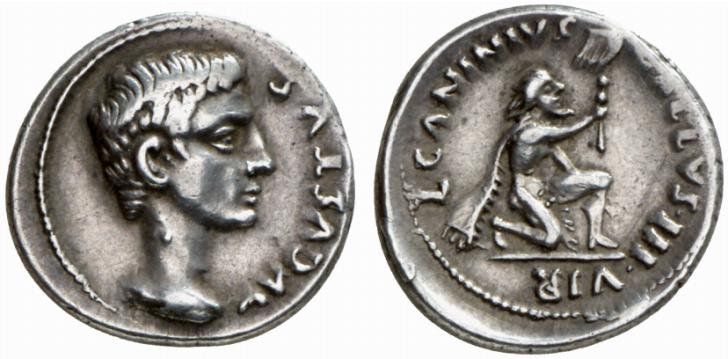 Roman coins with Caesar on it. Government's began to put their face on currency that cycled as to extend their control.
The Roman empire could not survive without its slaves, and yet we do not justify the slaves with the saying 'Render unto Caesar'.
No, I tell you, it is only the most perfect answer to the tricky question. It is like the middle school game where you ask your friend "Have you told your family you have AIDS?" If you answered yes you admit that you had AIDS. If you had answered no, you had admitted you had AIDS. It was a catch-22. While Jesus, so perfect, was able to overcome the Catch-22.
Taxes are an unlawful taking as we have no choice but to give and if we refuse we will be punished. As God gives us free will and does not restrict us from either choosing Him or against Him, why should we think He would restrict our choice towards government taxes.
So Render Unto Caesar What is Caesar's... Nothing.
 This is a case of the Lydian Lion: Considered by some as the world's first coin.
 Wednesday, April 23, 2008
The Message is the Same: THERE IS ONLY ONE TRUTH
Economics has lead me to believe in liberty. The ideas that have been fighting against coercion since the dawn of man promoting the life of any man.
The lessons from economics are simple. Free trade is needed to allow mankind to flourish and deny the pains which are poverty, famine, and death(not that death is a bad thing, but an early death such as the loss of innocent blood). Free trade spreads liberalism which denies any type of servitude, warfare, or coercive action. It is the ability for mankind to interact with each other and to increase their own satisfaction in life. Man lives only to increase his welfare and through trade with each other are we able to increase our own welfare and that of our families & friends.
The lessons from Christianity are simple. Jesus Christ gave us one law to follow, Love one another. Love is the simple answer that can and has changed the world. Love conquers hate. Love enables mutual, satisfactory interactions between individuals while Hate brings servitude, warfare, and a coercion. The Christian Church's message has been to speak out against Hate and to promote Love. This is the message that is spread and at the foundation of the Church is the institutions of friends & families.
The message from economics is that we, those who understand liberalism, must spread the word promoting liberty to whomever we can allowing for material wealth to spread to the corners of the earth increasing the welfare of all the citizens of the world.
The message from Christianity is that we, Christians, must spread the word that Jesus Christ has conquered death, conquered sin, and freed all the citizens of the world from all forms of control through his Love for us. All that is asked is we Love everyone such as He Loved us.
There is only one message; only one truth. Love will set us free and by love you do not create rules to deny the opportunity for an individual to interact with another.
TWO VIDEOS one from the Acton Institute and the second from Karol: A Man Who Became Pope (a touching movie everyone should watch, religious or not)
The lessons from economics are simple. Free trade is needed to allow mankind to flourish and deny the pains which are poverty, famine, and death(not that death is a bad thing, but an early death such as the loss of innocent blood). Free trade spreads liberalism which denies any type of servitude, warfare, or coercive action. It is the ability for mankind to interact with each other and to increase their own satisfaction in life. Man lives only to increase his welfare and through trade with each other are we able to increase our own welfare and that of our families & friends.
The lessons from Christianity are simple. Jesus Christ gave us one law to follow, Love one another. Love is the simple answer that can and has changed the world. Love conquers hate. Love enables mutual, satisfactory interactions between individuals while Hate brings servitude, warfare, and a coercion. The Christian Church's message has been to speak out against Hate and to promote Love. This is the message that is spread and at the foundation of the Church is the institutions of friends & families.
The message from economics is that we, those who understand liberalism, must spread the word promoting liberty to whomever we can allowing for material wealth to spread to the corners of the earth increasing the welfare of all the citizens of the world.
The message from Christianity is that we, Christians, must spread the word that Jesus Christ has conquered death, conquered sin, and freed all the citizens of the world from all forms of control through his Love for us. All that is asked is we Love everyone such as He Loved us.
There is only one message; only one truth. Love will set us free and by love you do not create rules to deny the opportunity for an individual to interact with another.
TWO VIDEOS one from the Acton Institute and the second from Karol: A Man Who Became Pope (a touching movie everyone should watch, religious or not)
Tax Freedom Day
Today we celebrate Tax Freedom Day. This is the last day of the year we work to pay off all the taxes that are taken from us by the government. Thanks to The Tax Foundation for the info...
and to celebrate our freedom, they even made a song.
I had thought about it and thought today wouldn't be complete without a little tune from the Beatles:
and to celebrate our freedom, they even made a song.
I had thought about it and thought today wouldn't be complete without a little tune from the Beatles:
Austrian Knights: China's Influence in the Western Hemisphere
Last night two Mason students, one a philo/econ major and the other a global affairs major discussed China's influence in the Western Hemisphere. They had found their sources mainly from the Woodrow Wilson International Center for Scholars in an article title Enter the Dragon; they had also had recorded a lecture series upon the topic which you can find here. The discussion relied upon the actions of China and its effects with Latin America. The state department has assembled their own study of the program here, and the Heritage Foundation has also had some work published here. It should be noted that the State Department's and the Heritage Foundation's work is from 2005 and therefore will not have some things brought to light by the Wilson Center.
For a brief summary of the paper, China wishes to bully Taiwan by taking their customers and intends on making its presence known as a world power by spreading its market network across the globe. China has thus increased its market activity within Latin America relying on the Latin American nations for food, oil, and other necessary resources for the growing economy within China.
The main fear is that the United States will then be surrounded by 21st century socialism and a rise of another cold war as China ties itself to national leaders such as Chavez, Morales, Castro, etc.
What answer are we searching for? The best conclusion has been given without this research, Free trade. If the U.S. would open its borders the ideas of liberty would spread out through out the foreign nations. Is there a policy such a Free Trade Policy needed in order to promote this system? Only if that policy is one sentence "There will be Free Trade"; anything else is unjustified and will deny the spread of liberty.
How then do we spread liberty? Is it the best to trade, to teach and spread the ideas, or is it to have a government involvement?
Note: I do not agree with the government involvement as by reading the conclusion of the State Department's statement, their solution is the Millennium Challenge promoted by Jeffrey Sachs, which most of us know is an insane policy which would not help the foreign nations.
The best answer therefore is to promote trade and the spread of the ideas. We need to get the actors, the artists, the musicians, and the writers to help spread the our views.
What do you think?
Should we fear China or is it just another ploy for the government to involve itself in affairs it has no need to meddle with?
For a brief summary of the paper, China wishes to bully Taiwan by taking their customers and intends on making its presence known as a world power by spreading its market network across the globe. China has thus increased its market activity within Latin America relying on the Latin American nations for food, oil, and other necessary resources for the growing economy within China.
The main fear is that the United States will then be surrounded by 21st century socialism and a rise of another cold war as China ties itself to national leaders such as Chavez, Morales, Castro, etc.
What answer are we searching for? The best conclusion has been given without this research, Free trade. If the U.S. would open its borders the ideas of liberty would spread out through out the foreign nations. Is there a policy such a Free Trade Policy needed in order to promote this system? Only if that policy is one sentence "There will be Free Trade"; anything else is unjustified and will deny the spread of liberty.
How then do we spread liberty? Is it the best to trade, to teach and spread the ideas, or is it to have a government involvement?
Note: I do not agree with the government involvement as by reading the conclusion of the State Department's statement, their solution is the Millennium Challenge promoted by Jeffrey Sachs, which most of us know is an insane policy which would not help the foreign nations.
The best answer therefore is to promote trade and the spread of the ideas. We need to get the actors, the artists, the musicians, and the writers to help spread the our views.
What do you think?
Should we fear China or is it just another ploy for the government to involve itself in affairs it has no need to meddle with?
Sunday, April 20, 2008
Why Austrians Appear to be so Negative: undergraduate response to Dr. Kling
Arnold Kling on his blog (EconLog) says:
What was preached by Hayek and now by Austrians such as Easterly? There is no way to predict the future. There is too much information within the market for any individual or group of individuals to be able to make any comprehension of it. Therefore there is no plan on how to predict a good time or a bad time, but when the government intervenes... information is given that allows for a prediction. That Austrians predict only bad times therefore tells us one thing, any government interference is viewed as the cause of a bad time.
To the extent that Austrians make predictions that sound falsifiable, they tend to be like Paul Krugman (who is not an Austrian), repeating a mantra "bad times are coming, bad times are coming" every year. Then, when bad times come they can say, "See, I told you so." It would be more interesting if every once in a while they predicted good times.From my studies, I have learned that it is easy to predict occurrences when we have information. Heck, anyone can do that; if poker players knew what each other had in their hand there would be no game. In football, if the opposing team knew something about their opponents offense they have a better chance of stopping them. The Austrians are no different. They continuously call out the bad times when there is government interference. Government intervention allows for more information which with common sense can be applied to predict the outcome.
What was preached by Hayek and now by Austrians such as Easterly? There is no way to predict the future. There is too much information within the market for any individual or group of individuals to be able to make any comprehension of it. Therefore there is no plan on how to predict a good time or a bad time, but when the government intervenes... information is given that allows for a prediction. That Austrians predict only bad times therefore tells us one thing, any government interference is viewed as the cause of a bad time.
Monday, April 07, 2008
Russian Video Conference- An Attack on Consumerism
 FROM GMU ECON SOCIETY BLOG:
This morning at 9 a.m. I found myself in a video conference in Research I on the Fairfax campus of GMU with a room full of sociologists studying globalization and a room full of students from Moscow who said they studied global economy. The topic for the discussion was consumerism. Peter Stearns, a provost at Mason, had started the session by giving a brief introduction to what he believes is consumerism and to how he believes it should be viewed and addressed.
The event turned to be a lashing out against what they have taken to be Consumerism.
Peter Stearns had roughly described consumerism as a deep interest of groups in acquiring goods they do not need. The purchase of goods that are not needed for survival.
Historically, Stearns stated, consumerism can be explained, but viewing that many societies were extremely hostile towards it the subject must be studied to comprehend why societies would want such a world. He had correctly turned to the 17th and 18th centuries with the Industrial Revolution and the beginning of the first globalization(trade with the colonies) as the source of the increase wealth which he saw as the reason why individuals began to buy the goods not essential to survive. To Stearns, consumerism grew because individuals wished to have things to identify themselves much like a wealthy person today purchasing a large mansion or designer clothes. He does not view this purchasing of material as a blessing but rather as an absurdity. Stearns had clearly defined his distaste towards the large debts most American citizens acquire in order to purchase these consumer goods. My response is simply, isn't it a good thing? We are receiving goods without even having to pay for them immediately. We are getting the upperhand within this deal. See CafeHayek for their so many blogs on this topic such as this recent one titled, "I [Heart] America's Trade Deficit"
I want to define here that consumer goods is never clearly defined. By defining consumer goods, as those goods which are not needed to survive, who is to say what is needed since what is needed for me is not needed for others. Bread has been the main food source for most of man's history. It was not until recently that man was able to have more choice in his food supply. In Mises' The Free Market and Its Enemies, Mises points out that Queen Anne of England had seventeen children; none made it to adulthood, yet with the Industrial Revolution, with the age of consumerism living standards improved allowing for the mortality rate to improve. Mises says, "from the point of view of the parents the improved life expectancy of their children may not have seemed merely materialistic(consumeristic)." In fact, Mises points towards consumerism as a gift. Before the Industrial Revolution, common man had bought his clothing through second hand stores. Clothing was handmade and a skillful task and therefore was only a good for the wealthy. The global trade with the colonies brought in cotton, a common man's good, which with the growth of industry began to be produced into clothing by mass production. Common man had improved his life by simply specializing and trading. Coffee, tea, sugar to our dear Provost are considered consumer goods, but to the common man in the 18th century this was a good that enabled him to feel as rich as a King. Today, common man can purchase an ice cream cone any day of the week. This is something that not even Kings could have enjoyed any day in the past.
Oh, Dear Provost Stearns... to claim that consumerism is what brings fault to many attacks upon the Jewish people. Throughout most of history, Christians and Muslims had believed charging interest to be a sinful act. They did not understand the necessity of the interest rate (a forward looking process), and as the Jewish faith did not have any law against such a practice, they quickly became the bankers and merchants. This perhaps may be one of the reasons why the Jewish people are viewed as always greedy. They invested and merely wanted their return, but to ask for repayment is sinful to other religions.
Provost Stearn, I was insulted to see your fear in globalization. This fear that consumerism, materialism, or whatever name it is we wish to impose on it is a greed that is useless and is devouring mankind. This materialism has provided for new forms of transportation, better living environments with air conditioning, and an increase of wealth that helps raise members of the society out of poverty. We do not want to spread this?
We have not even addressed the simple concept of comparative advantage.
To the dear Russian professors and students, do not fall for the faux pas. Trade is essential and a brilliant form of interconnecting mankind with one another. Why would anyone not want to have the goods that make you happy? We are not only producers but consumers... we live each day in purpose of bettering ourselves off for tomorrow. History is important so I am not trying to say that Provost Stearn is on the wrong track but to quote Mises' in Human Action. "The subject matter of all historical sciences is the past. They cannot teach us anything which would be valid for all human actions, that is, for the future too. The study of history makes a man wise and judicious. But it does not by itself provide any knowledge and skill which could be utilized for handling concrete tasks."
Sunday, April 06, 2008
FEE @ MASON!!
Foundation for Economic Education, now participating in university outreach, is hosting a full day of lectures at George Mason University on April 19th.

We have all heard the cries "IT IS NOT FAIR"
Well it is not, and FEE is here to help address the issues that are largely debated but hardly understood.
The issues will be from Foreign Aid; International Labor Standards; even to Institutions, Constitutions, and Economic Growth...
Speakers include Doug Bandow, Geoffrey Lea, and Joshua Hall.
Program for the event can be found here, and don't forget to register here, as it is to guarantee a copy of The Law (already have it? Good! Now get another to pass to someone else you may believe may benefit) and a lunch on Saturday afternoon.
The GMU Economic Society will kick off the FEE event the night before with a social gathering and a chance to hear from our very own Professor Bryan Caplan of The Myth of the Rational Voter fame.
Don't forget to sign up for the wonderful Summer Seminars at FEE in Irvington-on-Hudson, NY just a half hour outside of NYC!!! The seminars are first come first serve if you meet the criteria for the program basis, so act now and apply. Apply to more than one to increase your chances or to be the rare individual who gets to attend more than one...(note: Although you may get accepted to two programs, you may be asked to pay for the hotel accommodations for one of the seminar programs.)
Be on the look out for more information...

We have all heard the cries "IT IS NOT FAIR"
Well it is not, and FEE is here to help address the issues that are largely debated but hardly understood.
The issues will be from Foreign Aid; International Labor Standards; even to Institutions, Constitutions, and Economic Growth...
Speakers include Doug Bandow, Geoffrey Lea, and Joshua Hall.
Program for the event can be found here, and don't forget to register here, as it is to guarantee a copy of The Law (already have it? Good! Now get another to pass to someone else you may believe may benefit) and a lunch on Saturday afternoon.
The GMU Economic Society will kick off the FEE event the night before with a social gathering and a chance to hear from our very own Professor Bryan Caplan of The Myth of the Rational Voter fame.
Don't forget to sign up for the wonderful Summer Seminars at FEE in Irvington-on-Hudson, NY just a half hour outside of NYC!!! The seminars are first come first serve if you meet the criteria for the program basis, so act now and apply. Apply to more than one to increase your chances or to be the rare individual who gets to attend more than one...(note: Although you may get accepted to two programs, you may be asked to pay for the hotel accommodations for one of the seminar programs.)
Be on the look out for more information...
Wednesday, February 20, 2008
Liberty Fund has an Interactive Room Too Good Not to Share
AS POSTED ON GMU ECONOMICS SOCIETY BLOG
 Most know Liberty Fund for their catalog of books and online library. Now how about a chance to tour their online interactive GOODRICH ROOM. The room's walls have different names throughout history that have helped lead the argument on Liberty. From the Amagi and Gilgamesh to the Declaration of Independence. Each historical figure opens a new tab with a small historical note and its importance for liberty.
If you knew about the catalog but did not know about the online library, then it is time to get acquainted. It is a large database of online materials and difficult to decide where to begin. Liberty Fund has made easier and given us a starting point, HERE. You can log on to create reading lists, share with others, and view other members lists. Can it get any better?
ENJOY!
 Most know Liberty Fund for their catalog of books and online library. Now how about a chance to tour their online interactive GOODRICH ROOM. The room's walls have different names throughout history that have helped lead the argument on Liberty. From the Amagi and Gilgamesh to the Declaration of Independence. Each historical figure opens a new tab with a small historical note and its importance for liberty.
If you knew about the catalog but did not know about the online library, then it is time to get acquainted. It is a large database of online materials and difficult to decide where to begin. Liberty Fund has made easier and given us a starting point, HERE. You can log on to create reading lists, share with others, and view other members lists. Can it get any better?
ENJOY!
Subscribe to:
Posts (Atom)


